Gamification Strategies to Boost User Engagement in Fintech Applications

You pick up your phone to check your WhatsApp message, and in two seconds, you are on Instagram. You find one heart-wrenching music on Instagram and boom, you run off to Spotify. While you are enjoying that, you see a notification from Twitter about a new coin, and so you check if it's in your trust wallet. You are not done exploring the new coin; you are already on Paytm to check your account balance.Jumping from one app to another with a mission, but somehow mission NOT accomplished. The attention span of digital natives is decreasing day by day, which is a big problem. There is a high churn rate, low conversion rates, and what have you. This has pushed tech innovators to seek solutions, but did they get what they were looking for?Yes! You got that right. The solution is called GAMIFICATION. So, how is this a solution? Especially for Fintech ApplicationsSit back with a curious and open mind to understand the concept of gamification and its peculiarity with Fintech Applications.
The Psychology Behind Gamification, User Behavior and Engagement
If you follow the first paragraph, you will notice users have something they are constantly looking for a need or a want. There is something that motivates those needs, and Abraham Maslow, a sociologist, classified them into five high hierarchies: physiological, safety, love and belonging, esteem, and self-actualisation.While technology has found ways to improve all these levels of need, you will discover that the majority of digital products fall in the range of love and belonging to self-actualisation. This is a good indication that we have gradually shifted from problems with basic needs to problems associated with self-actualisation to a large extent.With great power comes greater responsibility. Voltaire, a French author.Problems with self-actualization require more psychological and sociological theories, and UX professionals need to be conversant with these theories to find a lasting solution to user engagement. In order to satisfy users' intrinsic needs, you can incorporate social features like leaderboards and community challenges to address the need for belonging,You see how Gamification comes in very handy.
Points to Note from Maslow
- User problems have evolved, and solutions should evolve
- The range between love and belonging to self-actualisation might be more expansive than we imagine
- Psychological and sociological needs can be satisfied. Research
Moving on to another school of thought on User Behaviour by B.F. Skinner. He demonstrated many facets of human behaviour by conducting experiments in his lab. One of his most important theories which was a result of such experiments was the principle of variable rewards. When a user doesnt know what to expect upon task completion, variable rewards are said to occur. This phenomenon is crucial in driving human behaviour and engagement.The unpredictability taps into the brain's dopamine system, fostering a cycle of anticipation, climax, and anticlimax. People like the feeling they get, so they come back for more. However, there is a dark side to this cycle, which will be discussed later.
Points to Consider
- Users are intrigued when they dont know what to expect.
- User behaviour = Motivation, Ability and Trigger.
- Gamification might be the right trigger for users.
Behaviourism is another theory to consider. It posits that human behaviours are a result of conditioning, and conditioning is largely influenced by our environment. It might be a one-sided approach to understanding your users, but it is definitely helpful in creating a condition for them. You have to use rewards (positive reinforcement) to encourage desired actions and penalties (negative reinforcement) to deter undesired ones.
Points to Consider
- The conditioning you can create is a reward system
- Beyond gamification, it helps you understand the whys behind user actions
- Behaviourism thrives on instant feedback
What is Gamification?
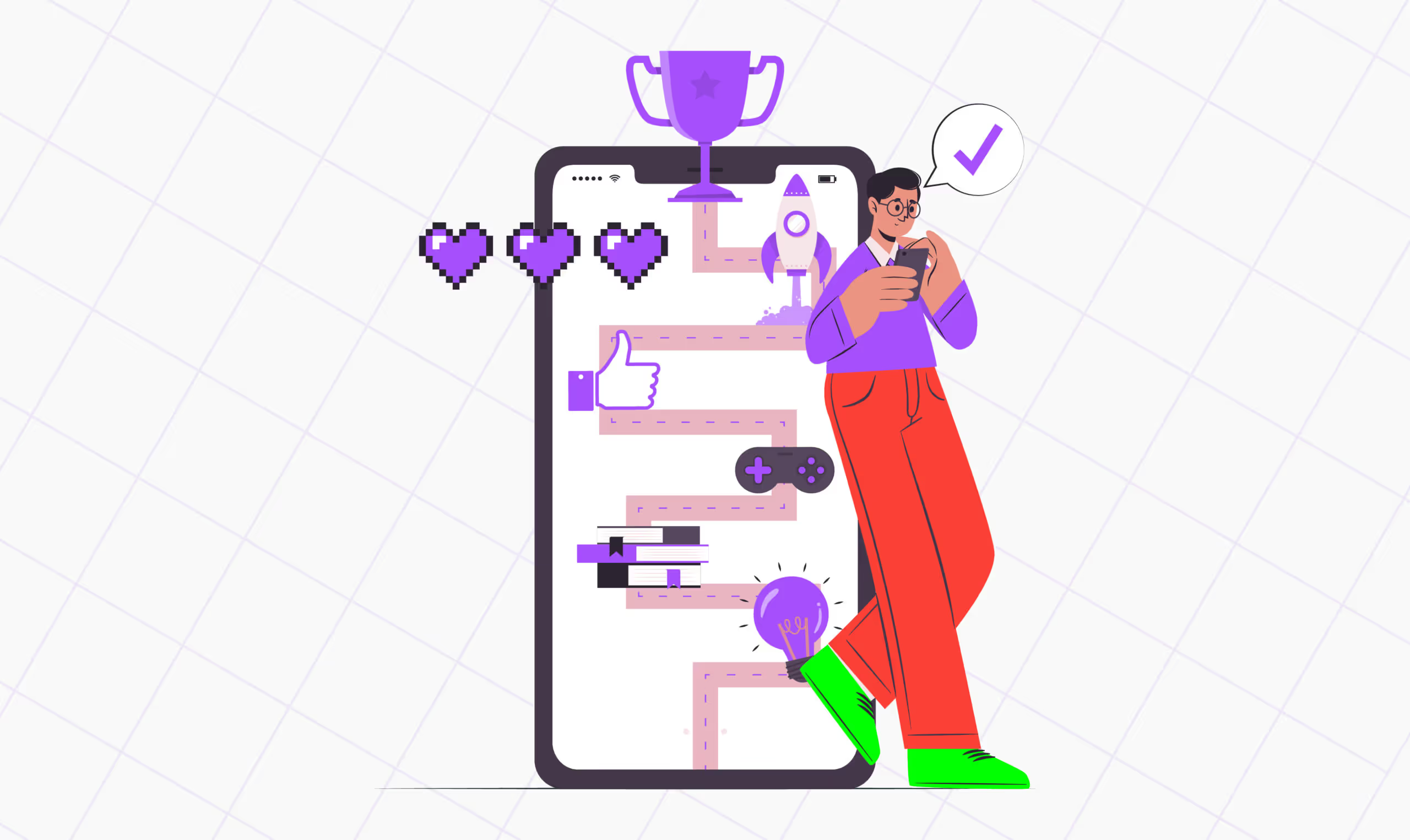
How would it be if you get 20 rupees for every 200 rupees you save?Happy? Curious? Interested?All of these are valid, and before you know it, youre looking for other activities to do, like updating your savings goal, checking your investment portfolio, and competing with your friends to see who hits their budget limit first.Congratulations! You just learned what gamification looks like. Now, lets combine words to make more sense of your newly found habit.The human brain is wired for engagement, and when Fintech apps understand that, they know exactly how to keep you around. Gamification is more of a psychological strategy than a visual appeal. It taps into your deepest needs and instincts and gives users a sense of progress and accomplishment.The progress, rewards, accomplishments, victorieswhatever you choose to call itcondition your user to stay until the end and keep them coming back for more.Just so you know, gamification has been around long before it was popularised to become a business concept. The scratch-and-win promos on popular children's snacks or drinks, the Q&AS on radio shows to win a prize, etc., all had a goal in common: to keep you engaged.So, gamification is the art and psychology of turning everyday tasks into engaging experiences by adding game-like elementspoints, badges, challenges, and rewardsto non-gaming environments. In a fintech application, its the difference between boring budget tracking and feeling like a financially disciplined person every time you hit a savings milestone.
Why Gamification Matters for Fintech
Fintech apps are constantly fighting for attention. The digital banking space is saturated already, and usersespecially younger ones (1835)arent exactly known for sticking to one platform. This situation becomes worse if the platform they use doesn't satisfy their needs.If your app doesnt spark some excitement, theyll jump ship faster than you can say hidden charges. Younger users are particularly drawn to this because it mirrors the gaming and social media experiences theyre already hooked on. Give them points for sticking to a budget, streaks for consistent logins, or rewards for hitting milestones, and watch your user retention skyrocket.Switching banking apps is as easy as switching playlists. However, you need more than just good featuresyou need a reason for users to stay. Gamification delivers that reason, blending finance and fun into one seamless, addictive experience.
The Benefit of Gamification In Fintech
Gamification sounds exciting, right? But it's even more interesting when you consider its effect on both businesses and users. Shall we?
Relevance to Business Objectives
Boosts customer retention and loyalty
There is something to keep the users, whether it's the 2% reward or a referral gift, they have something to look forward to. Life is give-and-take; you give them an incentive and get their loyalty automatically, provided all other things are equal. Other things like Trust, Customer support, user research, etc, can also support high retention.This increases the frequency of app usage and engagement. You can say goodbye to low conversion rates, high churn rates, bounce rates, etc. Users are now moved to talk about how good your product is to their friends, family and colleagues.
Sets fintech apps apart from competitors.
If you refresh any social media page, the probability of seeing a post from a fintech account is very high. Fintechs are everywhere! To stand out, you have to pull up your sleeves and get the real work done.How? So, what makes your product different? What makes your users stick to what you offer them? How do you keep the excitement from day one of using the app intact?Its obvious that gamification allows you to enjoy all these benefits in one. Its like turning a financial chore into a challengeand who doesnt love a challenge when theres a reward at the end? If you are building a fintech product, then you should include a gamification strategy.
Relevance to User Experience
Gamification does not just benefit your business; users have a giant share of rewards.It makes financial tasks less daunting and more enjoyable.Lets be honestmoney management isnt exactly everyones idea of fun. After waking up at 6 am every day to make it to work before 8 am, who then decides I want to reward myself with keeping my hard-earned salary?Jane McGonigal once said, Games make us happy because they are hard work that we choose for ourselves.Budgeting, Saving, and investing feel like self-deprivation most of the time. But if you throw in a bit of gamification, suddenly, its not just about crunching numbers. Its about meeting a reward benchmark. Its about the freebies on their next vacation or new house. You have shifted their focus from the task to the reward.It Adds a personal touch, making users feel more connected.The essence of gamification is putting users at the centre of their actions. In other words, Personalization is one of the trends you cant escape. It is an attempt to humanise finance, making users feel more connected and invested in their financial journey. You are giving them a financial buddy who cheers them on with every milestonebe it saving, investing, or budgeting.
This experience:
- Builds loyalty
- It makes users feel valued.
- Build habits and celebrate progress, one gamified step at a time.
Transforms financial literacy into an interactive experience.It creates an opportunity for users to learn. They learn all those Complex terms, confusing charts, and the bullish and bearish states by repetition. Many apps dump it all on users and hope for the best. But with gamification, you can make it engaging. Think about trivia challenges that teach users about budgeting or investment quizzes that offer rewards for correct answers.Instead of feeling forced to learn, users are naturally drawn in. Plus, theyre more likely to remember what they learn because its linked to a positive experience.
Core Elements of Gamification
What is a building without blocks, cement, sand, and water? You can not start any construction without these four materials. The same applies to Gamification; you cannot design an effective Gamification strategy for your fintech product without these elements. You miss one, and your entire structure could crumble. So, lets break them down one by one.

1. Objective: You need to define what user behaviour you want to influence. Otherwise, youll end up with too many activities with no direction, and your users will feel the confusion and chaos as well. Your objectives should be clear and SMART, and keep them to two or three.Do you want users to save more money? Make more payments through your app. Or maybe encourage them to check their account balances daily? Pick your objective according to the solution your Fintech Product is solving. Also, the gamification strategy should directly correlate with user actions. This objective will determine how to develop the remaining elements.2. Activity: How do you achieve your objectives? You need to create an activity that nudges them in that direction of your objectives. If your objective is to make users save more money, instead of just using a pop to tell them to save more. The activity could introduce a Save & Win challenge, where users who save a certain amount weekly get entered into a raffle or a leaderboard.Activities keep users on their toes. They create a sense of purpose and engagement, making tasks feel less like chores and more like games. Create the activity to be clear, intuitive, and achievable. Avoid overly complex tasks that may frustrate users and lead to the low engagement you are trying to solve.3. Instructions: You should have it at the back of your mind that no matter how simple an activity is designed, its just one step away from improvement, new knowledge, trick or misunderstanding. You dont want users to abuse the gamification, and you run at a loss.The instructions will tell them the dos and donts of the system. Its like a rule or regulation guiding the users to avoid the tendency of abuse or addiction. If youre introducing a point system, explain how points are earned and what they can be redeemed for. If users can unlock levels, outline the criteria for levelling up. Transparency builds trust. Users are more likely to participate wholeheartedly when they know what's expected.4. Reward: Users' efforts can't go to waste, so you should offer incentives that match the effort. You cant tell them to share the link with 100 people for just 1 rupee; no one will take you seriously. If users invest time and energy in completing a challenge, make the reward worthwhile.As a designer, you have a Job to do. Test reward systems before rolling them out. Make sure users actually value the incentive. Theres no point in offering a reward that users dont find exciting.5. Fun: This is a no-brainer: Gamification is based on fun. No matter how great your objectives, activities, and rewards are, if its not fun, users will bounce off your competitors. Inject a little personality into your gamification strategy. It could even be your branding element or something personal to users. Use vibrant visuals, playful language, and even a bit of humour. Balance fun with functionality. Dont overload the interface with too many gimmicks. Fun should be a subtle enhancement, not a distraction.
How to use Gamification in Fintech
Gamification is not the regular design strategy you can easily jump into; you need a process and planned tactics youll follow.
Identify the Behaviour you want to change.
Before thinking about gamification for your Fintech app, identify the behaviour you want to bring about or alter. Gamification should stimulate healthy and positive actions.It could be to nudge users towards good money habits like budgeting, setting saving goals, or dipping their toes into investing. Or you may want to make them used to one of the new functionality on your fintech app.Some specific behaviours you might want to influence in Fintech are:
- Saving routing encouragement: You can encourage your users to create better spending and saving habits with incentives like points or cashback.
- Financial literacy: Its easier to spend more money than you earn, and its important to help your users manage their finances through educational content and other app-enabled features.
- Encourage Responsible spending: Consistency encouragement to budgets and minimising excess and unwanted spending.
- Increasing investment activity: allows users to find and interact with investment opportunities (maybe via simulators).
- Enhancing security practices: Educating users on security practices and encouraging the adoption of secure habits.
- Debt Management: Its easier to pay debts in the form of monthly or weekly bills. You can create a system that adds their debts to bills!
Name Your Game
A point system is among the most well-liked gamification features, so you might want to consider it. But you should also strive to be different by giving it a more trendy and relatable title. It could also be related to your brand or what your users are familiar with. This will make the user experience more enjoyable and memorable.These are some fun examples you can try out:
- FinPoints
- SaveStars
- InvestCoins
- GrowGems
- CashKeys
Naming the game is not restricted to only points. Experiment with other features in the gamification strategy like customer support, onboarding tasks, achieving milestones, getting financial quiz questions correct, sticking to a budget, frequent or daily app logins, etc.).They can be used to motivate players to adopt desired behaviours and show improvement. Pick something that fits your brand personality, and watch user engagement increase!
Storytelling in Gamification
The idea of narrative is one of the aesthetic components of the MDA framework for game design, which can contribute to making a gamified experience "fun". Storytelling can be used non-intrusively in Fintech by positioning financial journeys as quests/adventures. For instance:
- If saving for buying a house, it could be framed as "The Homeowner's Quest," with badges or levels displayed across a map of progress at every milestone.
- How to invest could be framed as "Unlocking Investment Secrets," with rewards coming as every module is completed by revealing more of the narrative where the user earns rewards.
- Creating a budget can be turned into a game as "Mastering Your Financial Kingdom," where sticking to the budget earns the player "Prosperity Points" and reveals new "territories" (financial goals).
Do not make the storytelling so complicated like in Video games, such as COD, PUBG, etc. Be subtle with basic visualisation of progression, naming successes/losses names. It gives users a sensation of journey and success.

The Gift of Reward
Rewards are the gamification; without them, gamification is a chore. They're what get people interested and keep them motivated. You are tapping into the internal motivation (feeling good about progress) and the external reward (getting something concrete).Now that you know the behaviours you want to influence, you can play around with different forms of rewards to motivate those behaviours.
- Badges are visually pleasing rewards for accomplishing a particular milestone, overcoming challenges, or displaying certain positive behaviours. People see them as a badge of honour. Theyre equivalent to getting a medal during a sporting activity, and they can be displayed on user profiles.
- Levels: This gives users a sense of progress or ranking. Many people feel tired in a work environment after 3 or 4 years, so why subject your users to the same position in your app? Its their finances were talking about here. Levels allow users to get an idea of how they are growing in their financial lives.
- Virtual Currency: Remember, naming your game? You can create coins or tokens for users to earn and use within the app for various purposes, like unlocking app features or personalisation options. Its a win-win for you and the users.
- Leaderboards: Allow users to compare their progress to others (if they wish to compete), allowing room for healthy competition. Nevertheless, do not focus on competition alone as a gamification strategy because it might discourage some users.
- Tangible Rewards: Think about providing real-world rewards such as price discounts on financial products, gift cards, or even small cash rewards as incentives for achieving important financial milestones.
- Social Recognition: People love social Validation, so create systems that allow users to share their success with friends or within the app community, forum or other social media platforms.
- Premium Content or Features: Exclusivity means a lot to people for psychological reasons. So, beyond your regular games and points, give the users more advanced tools or access to certain features to reward their engagement, participation, or achievement of certain objectives.
- Personalisation Options: Giving users the option to personalise their app to their own tastes and preferences. This could be employed as a reward for advance.
The reward should be enticing, valuable, and gradual (rewards are gradual progress, not quick success). External rewards and intrinsic motivators like autonomy and belonging are both required. Relying only on external rewards by themselves can de-habituate intrinsic motivation.
Make use of Social Media.
It's a great way for users to brag about their achievements. like finishing onboarding or reaching a savings milestone. Keep them hyped while screaming about your app online by:
- Sharing Successes: Users should be able to share badges, level-ups, savings milestones, or successful investment returns on their social media pages.
- Referral Incentives: Users can be rewarded for friend invites or by app referral.
- Social Challenges and Competitions: Run time-limited challenges or contests on social media sites that tie back to your app, giving participants in-app rewards or real-world rewards.
- Community Building: Encourage users to socialise and express their experiences on the app, particularly social media groups, to create a community.
A Little Personal Touch
Do you know what truly makes gamification succeed? Making it all about the users! When you rent your house, the next thing is how to make the space feel like you, right? The same is applicable to fintech apps.You cant learn about each user, but you can give them the opportunity to customise how they want their app to look. Imagine being able to let people personalise their own gamified experience. It can be tweaking a savings tracker or choosing a budgeting style that won't be a drag.
Personalisation can be done in many ways in Fintech:
- Goal Setting: Allow users to define their own financial goals according to the service you offer (e.g., save money for some product or event). Then, tailor your gamification strategy according to those goals.
- Reward Preferences: Maybe give the users a choice of selecting the types of rewards they find most motivating.
- Learning Styles: If your gamification contains educational elements, tailor the content and restrictions to different learning styles.
- Segmented Experiences: Use tags to segment people based on their financial goals, behaviours, or demographics and offer optimised gamified experiences and leaderboards. For example, you can think of new investors being offered a different onboarding experience than experienced traders.
- Context-Based Personalisation: Filter game mechanics by the user's current setting or theme within the app to provide the most contextually relevant and practical experience.
Feedback and Warning Signs
There's a small gamification secret that totally makes sense, and you cant afford to sit it out in your gamification strategy. It's all about giving feedback that actually means something and fast!Feedback must be immediate, clear, and actionable. When an app sends you a beep after you've purchased to tell you, "Good work keeping to budget!" or shows you your savings journey so you can see what has changed. It also gives users a sense of direction and focus.You can use progress bars, performance reports(e.g., Spotify Wrapped), points and badges acquired, reminders, and notifications to keep your users updated and responsible for their actions.Those alerts also serve as warning signals to keep you on your toes! If there are unusual spending spikes or not-so-great trends or issues that can wreck user goals, your gamification strategy can be their friend tap them on the shoulder and say, "Hey, heads up! something's off!" For example
- Send reminders when you spend above budget.
- Reminders if savings contributions fall behind schedule.
- Visual reminders when debt levels are increasing.
But be careful to always balance negative feedback loops (feedback to avoid bad habits) and positive feedback loops (feedback to reinforce good habits)
Instant Gratificati

Let's create something amazing!
Let's discuss your vision and how we can bring it to life with impactful design solutions.
.avif)
Good design starts with Sliced Newsletter
Subscribe to the Sliced newsletter and get the best of research, UX writing, product psychology, CX, and design systems, right in your inbox.