Designing Conscientiously: A must skill for every designer


Anthony Fernandes
Ethics is not limited to corporate professions like lawyers or doctors; it is a must-have in the tool bag of every technology-inclined professional. Adapting ethos and ethics starts with the designer, especially now in the age of intrusive technologies and the face of business profit. Narasimman Rajendran did justice in equipping our designers with the skills to design for people rather than users.
Who is Narasimman Rajendran?
" The best and most beautiful things in the world cannot be seen or even touched - they must be felt with the heart."- Helen Keller.Narasimman is one of the rare people who loves to be called by the short form of their name, Nars. On a more serious note, he is an amazing designer with over a decade of experience, evident in how he poured out his heart as he taught.He started as a graphic designer even though he had an engineering background. What did you hear about graphic designers who transitioned into product designers? You cant beat them in their game! He joined Axio at the top, starting as the UX Team lead and now as the Vice President of Design.Introverts are not as quiet as they seem. They get really passionate about what they love doing and talk about it extensively. It is like they save their strength for the best. Nars is that kind of introvert who is also very empathetic and compassionate, in case you wonder why he is so good at the thing called Design.He has learned the art of mastery through his years of experience in marketing/advertising design and print design until he found his callingproduct design. His choice was based on his desire to make an impact in peoples lives while expressing himself. You can applaud his efforts on many Indian and international brands like Xiaomi Easy and Trip Money.
Have you heard about Superpower as a designer?
Nars told us about his superpower, which he explained as championing a future where problems are solved with innovative, human-centred solutions. With great power comes responsibilities , Voltaire, a French author.As designers, we wield power gained from the days and nights of rigorous learning and years of experience.Empowering a bright future is a great responsibility, and that's where our powerour skills and experiencecomes into play.He consolidated his explanation with the fact that early men began the journey of evolution, which went on to the Stone Age and the Industrial Age. The baton has been passed down to us in the digital generation to innovate for the coming generations.
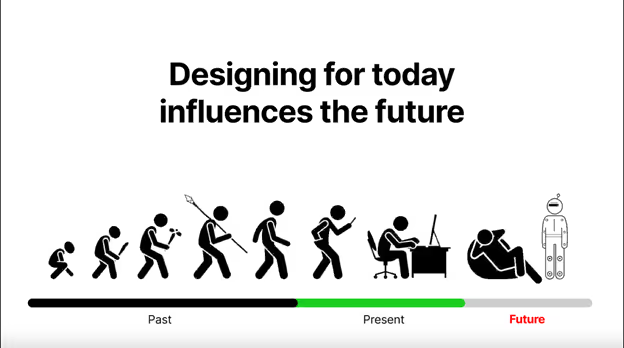
Will the future look back at our innovations and applaud us, or will they look back in pity and shame? If the Industrial Revolutionists should travel into the future, will our innovations and design be more than their expectations? These are the questions to keep in mind while solving a problem, especially through design.
Designing Conscientiously
Nars used his one hour judiciously by giving background to his teaching and breaking down everything that constituted designing with ethics. He started with the framework that makes up a good design.In government class, Autonomy is freedom, and we have seen examples of how colonialists gave full autonomy to the colonized state after the fight for independence. In the same vein, state governments have complete autonomy over their jurisdiction. As a designer, give your users the autonomy they need.Designing conscientiously means giving your users the confidence to navigate your solution, whether it is digital or physical. The solution we are designing should not hold back any helpful feature that can be weaponized as a business strategy to bring profit. After all, the success of a product lies in being profitable for both the user and the business.The autonomy of the user should include but not be limited to:
- Avoiding invasive algorithm and observations that judges the user
- Right to independent choices and freedom to navigate
- Provide control over personal data, privacy, and sharing preferences.
Actions have Consequences, right?
What happens in the case of accidents or mistakes? Should your users suffer from an error that can be avoided? Another gem Nars gave us is Consequencesthe consequence of our design choice, the implications of a little mistake that blows out into proportion.He told us to avoid potholes in our design that users can drown in while using our product. For example, users can lose access to a progressive journey during a network failure. We can see how Google Forms works. Every update is synced with the cloud, and even if there is no network or the user leaves the page willingly, they return to where they stopped.
Accessibility is the ongoing design Trend.
Accessibility was born out of the need to create an inclusive environment, so if we are to empower the future, it has to start now! Our design process should target users from all walks of life. Inclusivity means treating and respecting everyone because they are human.He advised us against undermining the abilities of people living with disability and over-glorifying their situation in a way to push positivity.The other framework he mentioned is Wellbeing, Care and Sustainability, which are interrelated but also independent. Prioritizing the well-being of users seeks to reduce unmindful/ excessive usage of a product. We should take the role of a healthcare professional in our designs. We all see medicines with cautions like Do not use out of doctors prescription or Keep out of Childrens reach It doesn't mean the Pharmacists are not looking at making money but because they have prioritized their patients' well-being.
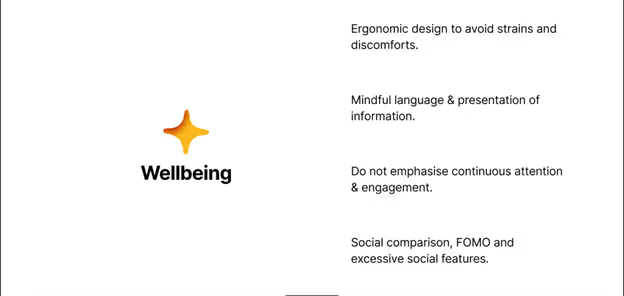
Caring for your users complements their well-being. It means making sure your design has a way to check in on them. Encouraging healthy practices, providing moral values alongside functional values, and empathizing with them by observing their performance shows that you value them more than the revenue you are getting from them.Finally, sustainability creates the opportunity for continued usage. His explanation is premised on three things:
- Build efficiently to be used efficiently
- Educate and Promote to make greener choices
- Ensure Continuity of Usage
Ethical Considerations in Design
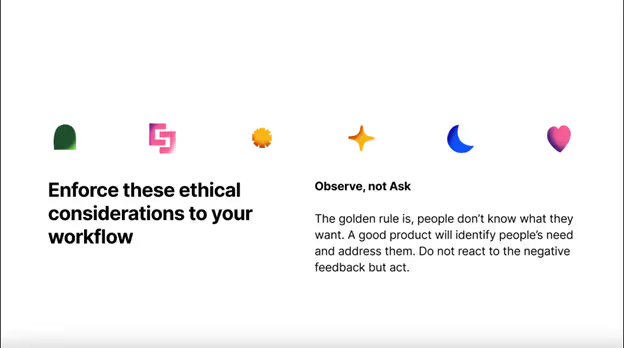
Now, let's look at how these five frameworks will help enforce ethical considerations in design.
People, not Users
It is worth noting that the people we are designing for are users, but they are more than users; they are humans. They are not just the user persona we design. Nars told us to actualize this from an organizational perspective rather than a designer's perspective. This would enable united solutions that do not proliferate to more problems.
Together, not Solo
As designers, we are used to taking solace in our creativity and making amazing designs, but we forget that two heads are better than one. If you can develop a unique design solution, how much more inviting the whole house to brainstorm? We should consider designing together with other stakeholders, not solo.
Act, not React
The next consideration is acting and not reacting. According to Nars, a Reaction is like a short-term solution to design problems that require a complete design process. He gave an example of releasing or testing a product that doesn't meet its KPI. He said that many designers try to patch the problem up and give it to users when they should take time to understand why the users are having difficulty. Then, they should act on their research to come up with a mind-blowing solution.
Observe, not ask
One quick tip is that Users dont know what they need, a good product will identify it Narasimman.Humans do not respond to their software by communicating; there is an emotional bond attached. So, what makes you think asking your users questions will reveal what you need to design for them? We can observe their pattern of usage, their needs, and how the product satisfied them.
Contribute, not Co-pilot.
As designers, we should contribute, not just co-pilot. Collaborating has its ups and downs, and one of them is not being able to come to terms with design aesthetics, functionality, and how to generate profit. The previous yellow Insight addressed this issue by saying Design needs a seat at the table. The Business, design, and development teams must leave their differences and individual ideas to build what the users want.
Responsibility, not Superpowers
As we bring this to a close, remember Nars talked about Superpowers as responsibility. It was a perfect foreshadowing for us to understand this last consideration. We should consider responsibility, not Superpower. It is not by being powerful but by using your powers for the greater good. Designers should take responsibility for the users and the future of innovation. The responsibility(Superpower) comes with knowing that your design can make or mar society.
Questions and answers
What is our Yellow Insights without questions from our designers? Lets take one of the questions and leave you to get full access to Nars' teaching.
Kishor: You talked about inclusivity. What is your opinion about societies/organizations like AAA and WCAG guidelines to enforce inclusive designs?
If designers dont have regulations, society will definitely bring them for us. It doesn't speak well for us to wait until the government or activists start telling us how to design right. So, I think it is a good idea for designers to establish guidelines or publish a framework for ethical designs.
Designing for the Future
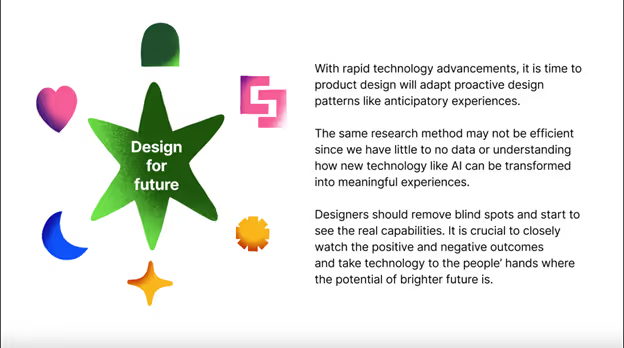
Nars told us that if we follow the considerations and frameworks he discussed, we should be confident that we are in the right direction. He urged us to be prepared for what comes next, like trying to design for recent technologies. We all think of AI as that technology that is changing the face of the digital age.We see what works and what does not, what empowers people, and what does not. Thus, we can ascertain the outcome of these technologies responsible for a brighter future.

Let's create something amazing!
Let's discuss your vision and how we can bring it to life with impactful design solutions.
.avif)
Good design starts with Sliced Newsletter
Subscribe to the Sliced newsletter and get the best of research, UX writing, product psychology, CX, and design systems, right in your inbox.