The Funnel Approach in UX Research: A Step-by-Step Guide to User Insights

People will often say that if you go to the mall with a vague idea of what you want, You end up buying things you don't need, and if you are unlucky, itll be way more pricey and substandard. You want a shoe, right? The follow-up question should be, which brand? Followed by the size or colour you want.No wonder our mothers go to the market with a list. So they don't go out of budget, they do not forget what they need the most, and, more importantly, they don't buy what will not serve them properly.We barely understand user needs without any research or streamlining the research, so as designers, you can fall into the problem of making pricey solutions that the users won't even bat an eye to.User Research will help you understand their needs and problems. However, don't you think it is more rewarding and productive to narrow down their feedback rather than diving into your user base and getting all kinds of feedback from them?Back to the sneakers, you want to buy the questions you asked, so simply use the funnel approach to solve your problem. UX Research also works the same way as the Funnel Approach. At the start, you have a broad view of user behaviour, needs, and motivationsjust like browsing the entire mall. But as you move forward, you refine your focus, filtering out unnecessary information, just like choosing the best sneakers.
Where did the Funnel Approach in UX come from?
This technique is not new; it is very common among sales and marketing professionals. They use it to filter their leads in their strategy. They understand that it helps them classify their leads and provide solutions for each category accordingly.A sales funnel is the pathway to turning potential customers into paying customers. It is like a psychological box where you try various selling strategies to unite your target audience. You then convince them that your product is the ultimate solution to their needs and make them buy it. It sounds simple, but implementation is the real deal.It is different regarding UX design; the subjects in the funnel for UX research are the questions and inquiries, and for sales and marketing, the subjects are the leads.
What exactly is the funnel Approach in UX Research?
It begins with a broad perspective, gathering general observations and behavioural patterns. As the research progresses, the focus narrows down step by step, filtering out unnecessary information and focusing on the most relevant insights. So, it guides user inquiries from generic to specific.This approach is best used with qualitative research methods like user interviews, usability tests and feedback analyses. However, it doesn't mean it would not work for a quantitative approach. It makes sure that researchers do not jump to conclusions too early. Instead, they take time and due diligence to get to the root of user behaviours, pain points, and motivations.UX researchers can:
- Start with broad, exploratory questions before refining their focus.
- Identify patterns and trends before zeroing in on specific user issues.
- Avoid biased conclusions by structuring data collection logically.
- Improve the reliability of insights, leading to better design decisions.
Why understanding the Funnel Effect in UX Research is crucial.
UX Research is broad and requires a lot of mental energy. The funnel technique is one of the methods that make UX Research more productive and rewarding. As a designer or Researcher, you would need the funnel technique, and there is no better way and time to learn about it than now.This technique will help you to:
- Start with Open-Ended Exploration: Researchers begin with broad, general questions that encourage users to express themselves freely. This ensures that no key issues are overlooked and that all issues have a fair chance of being thoroughly evaluated.
- Gradually Refine the Focus: As the research progresses, follow-up questions and usability tests become more specific, filtering out unnecessary data.
- Categorise User Insights: Instead of dealing with scattered feedback, researchers classify insights into meaningful categories, such as usability issues, user motivations, and feature preferences.
- Prioritise Actionable Findings: The final stage of the funnel ensures that only the most relevant and actionable insights are used for design decisions, improving the overall product experience.
Importance of Funnel Analysis in Digital Products
Digital products thrive on user behaviours, and funnel analysis is one way to get to the nick of users. The Funnel Analysis technique maps out the user journey, tracks drop-off points, and identifies areas that need optimisation.Digital products can include e-commerce checkout flows or SaaS onboarding experiences. The funnel analysis will help you narrow your focus on creating an interaction or experience that increases user engagement and retention.
- Understanding where users drop off by analysing different stages of user interaction, teams can identify friction points in the user journey.
- Optimising conversion rates in an onboarding process, a checkout flow, or subscription sign-up, Funnel Analysis helps pinpoint where users abandon tasks.
- Improving usability by guiding UX designers to simplify navigation and reduce cognitive load. This improves overall user satisfaction.
- Validating design changes by tracking how improvements affect user behaviour. The result ensures that updates are data-driven.
- Enhances usability testing
- Reveals why users abandon tasks
- Identifies user hesitations
- Helps Structured flow of questioning
- Improves Usability Testing by Focusing on Key Stages
- Enhances Conversion Rate Optimization (CRO)
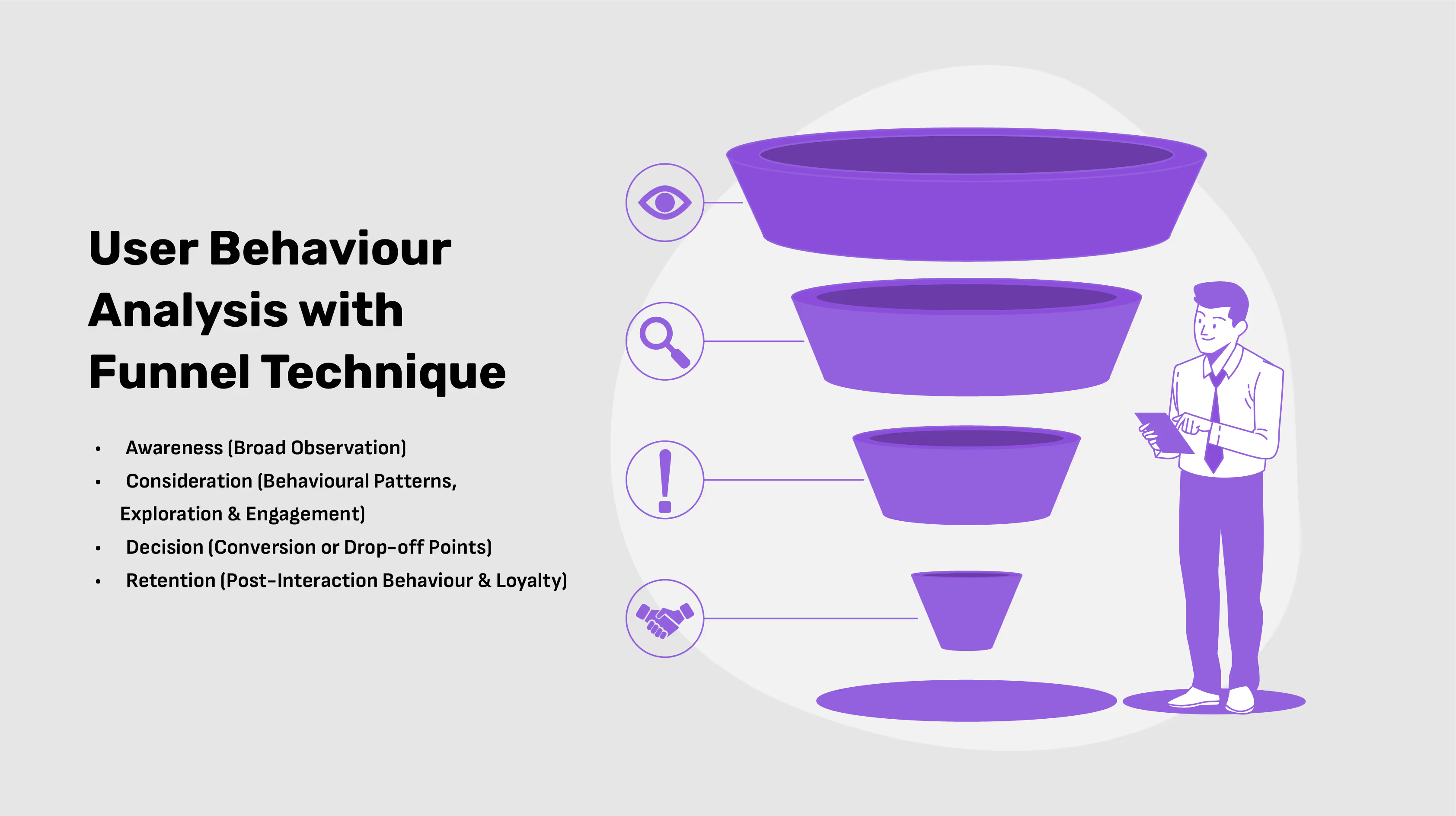
In recent times, there has been a lot of interest in the interaction between UX and user psychology, or what we also refer to as behavioural science. The design community is paying more attention to better understanding user behaviour/ psychology. As we can see, this has a far-reaching impact on design, especially UX design.Behavioural science helps us understand user behaviour, its motives, and its effect on a product. The Funnel Technique structures user behaviour analysis by segmenting user interactions into progressive stages, making it easier to identify drop-off points, bottlenecks, and successful interactions.It works similarly to the sales funnel, as users are classified based on progressive stages. Behavioural analysis tells us that:
Behaviour = Motivation+Ability+Trigger
The desire and action to pay for a service are fuelled by both internal and external factors. Therefore, using funnel techniques helps you understand your users and guide your ideal customers to do what you want them to do.
The stages in the Funnel Technique for User Behaviour
Awareness (Broad Observation)
The aim is to get information about how your product got their attention. What is their first impression of your product?Users land on the product through various entry points (homepage, search, ads, referrals). As a Researcher, you should observe first impressions, navigation behaviour, and engagement levels. Then, you can proceed to ask questions like the examples below to give you answers to your observations.
- How do users arrive at the product?
- What actions do they take in the first few seconds?
- Where do they go first?
Consideration (Behavioural Patterns, Exploration & Engagement)
Users explore the product by interacting with features, browsing content, and evaluating options. This stage is fuelled by the internal desire of the customers to know more about their problems and how your service can help them.It is upon you to analyse which paths users take, which pages get the most engagement, and where hesitation occurs. The questions thatll help you narrow down include:
- What features do users engage with the most?
- Are there unnecessary distractions?
- How long do users spend on key sections?
- Do they mirror their problems and see a solution?
- Is there something that piqued their interest?
Decision (Conversion or Drop-off Points)
This is where all your effort becomes a huge success or a total failure. From about 1000 traffic at the beginning, you are left with probably 500 people here. Users either complete a desired action (e.g., sign-up, purchase, booking) or abandon the process. Funnel analysis pinpoints exact drop-off points and potential roadblocks.So, the questions to guide your research include:
- Where do users drop off before completing their journey?
- What elements may be discouraging conversions?
- Are users provided with the proper guidance and motivation to continue?
Retention (Post-Interaction Behaviour & Loyalty)
The fact that your user has bought your product or paid for your service doesnt mean the journey ends there. Users who successfully complete an action may return for further interactions or disengage after their first visit.Behavioural analysis helps you understand post-conversion behaviour. The result will help you optimise retention strategies. The following questions will help you get started.
- What percentage of users return after their first interaction?
- Are there features or notifications encouraging re-engagement?
- What does user feedback suggest about long-term satisfaction?
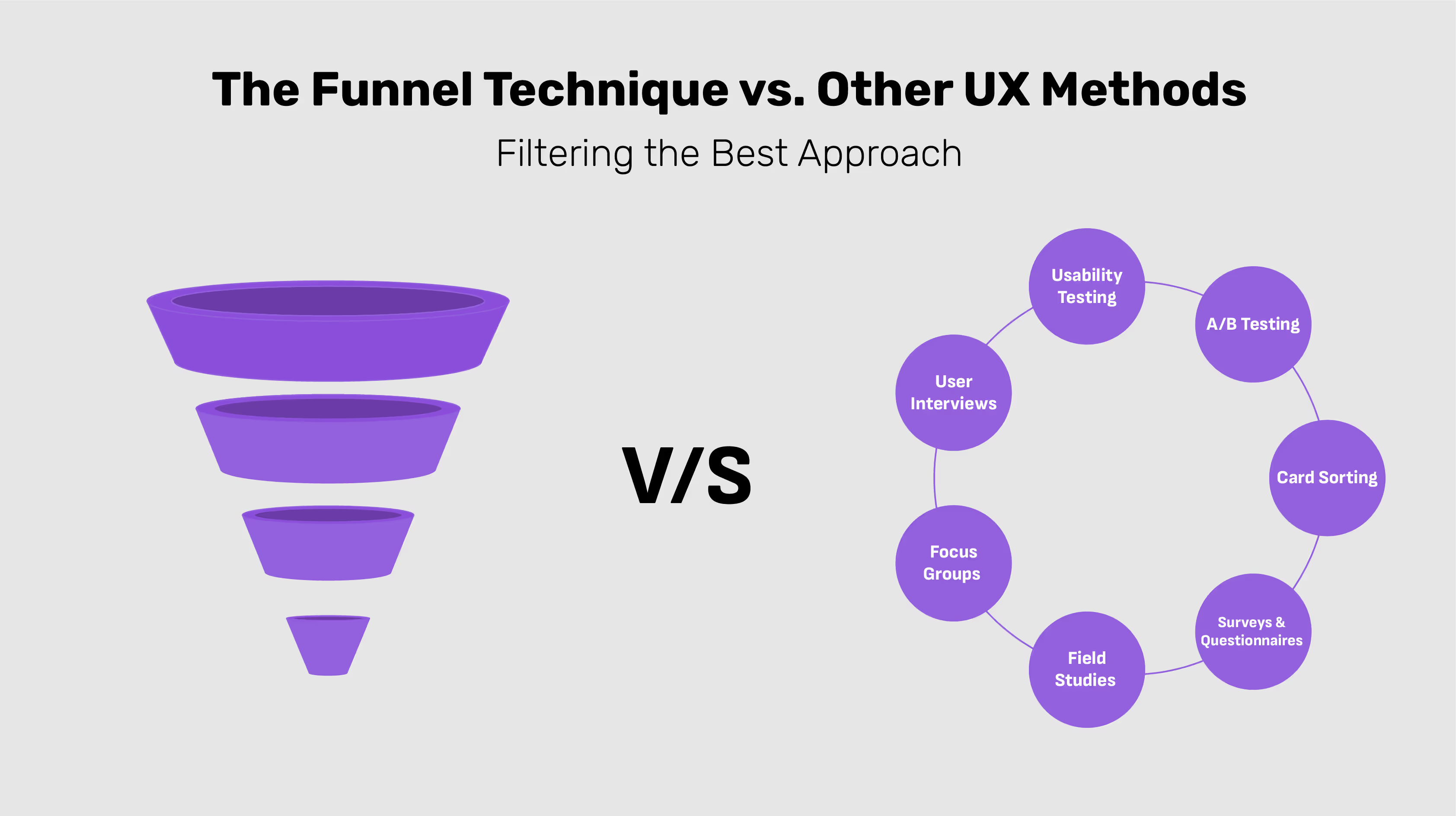
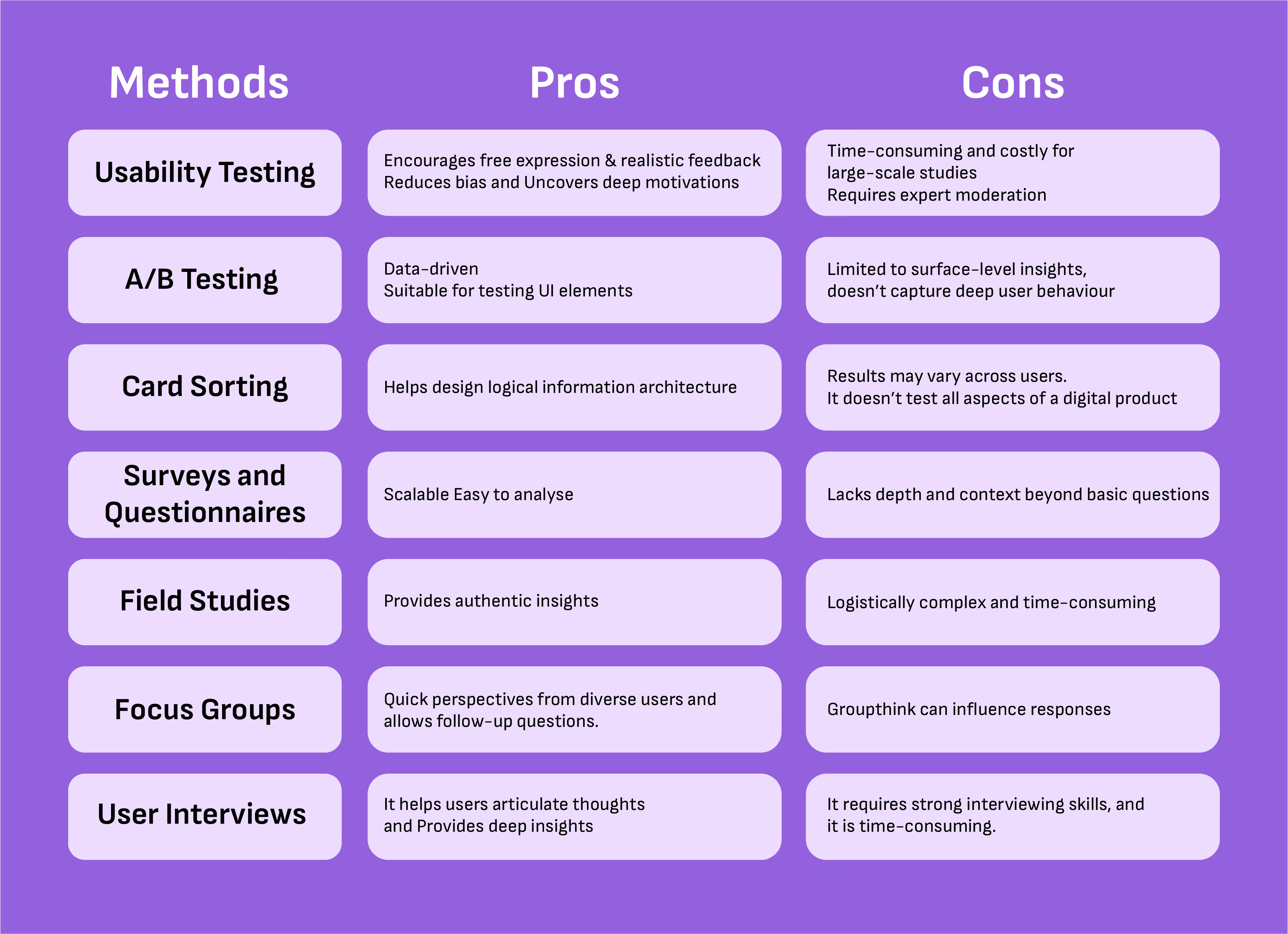
The funnel technique starts with a broader scope of questioning, moving to specifics. It sure is one of the best techniques to conduct user research, but its not the only one.In many instances, it can result in fruitful outcomes, but does it stand the test of time compared to other UX research methods? Thats the discussion we will have under this subheading.Its best for the initial discovery stage, where you can couple it with techniques like interviews and surveys where user exploration is the goal. These techniques help gain deep knowledge about user behaviour and thought processes.These techniques encourage free expression at first, reducing bias and uncovering deeper motivations of users that even they are unaware of. One-on-one research findings of this generative research process in interviews and surveys reflect the pain points faced by users.However, the funnel technique can be time-consuming for large-scale studies in more significant projects. This technique needs expert researchers to use skilful moderation to avoid discussions that can lead to unnecessary questions.
A Look at Other UX Research Methods
Here are a few UX research methods used within the funnel technique to collect user data. We compare these methods and tell you which one to opt for and when.
Usability Testing
Usability testing is a one-time approach that observes users as they complete tasks in a digital product. This helps designers identify usability problems in real-time on their products.Because this method is used after the product is designed, users' initial expectations are ignored even after this method is used. Hence, a combination of methods must be used to understand the user's needs.Alone, usability testing cant do much to gain feedback from users, but when coupled with other techniques that gather feedback before the process of designing starts, it can help a great deal.
A/B Testing
In A/B Testing, two versions of a product with two features in a product are tested to see which one works the best. It works well when a specific UI element needs to be tested for engagement, and the designers are confused between two options.However, this cant be the only method to gain user behaviour because it only works when you have two versions to test.
Card Sorting
Card Sorting is a method in which users are asked to categorise information. It helps understand how people logically think about content organisation.For instance, while designing information architecture, designers can ask users to segregate information so that they can intuitively understand what makes sense. When they use the app, what comes naturally to users, though results may vary by participant understanding, is more or less the same for all users.
Surveys and Questionnaires
As mentioned above, surveys and questionnaires are best performed initially. To gain the most basic information about user behaviour, it is a structured way to ask questions that are often quantitative.Collecting data from large groups of people becomes possible through this. However, this method is not appropriate for research where depth and context are needed beyond just basic questions and answers.
Field Studies
Field studies allow users to be observed in their natural environment, allowing researchers to understand how they act in an environment where they belong. This is a great way to gain knowledge of real-world behaviour and provide authentic insights.
Focus Groups
Focus groups are a bunch of people, usually experts, but they can be regular users, too. They are brought together to discuss a subject to solve a problem or suggest some ideas.This is a discussion-based research with multiple users to explore collective opinions and reactions towards a digital product or a specific product feature.Focus groups are a good way to get quick perspectives from a diverse group. People who think in groups can influence each others responses and provide excellent help with the project. Focus groups also allow you to expand on the discussion and ask follow-up questions.
User Interviews
Another effective method to collect qualitative feedback from your users is interviewing them. Exceptional interviewing skills are needed, as they can be conducted remotely and in person.User response in real-time can help significantly as non-verbal cues can be considered. With the right questions, users can articulate their thoughts clearly and answer in a manner that allows the research.Most of the time, users dont know why they act in a certain way, and even if they do, they cant express their feelings. However, with the right nudge from the interviewee, they can trace their inner feelings about a product.
A quick look at other user research methods.
Types of UX Funnels and How They Shape User Journeys
The stages we mentioned can accommodate different funnels; you can build one at any stage in the customer journey. A strict customer journey doesnt exist; it depends on the product; similarly, a funnel classification doesnt exist.In UX, there are different types of funnels, which we have discussed below,
1. Marketing Funnels
Marketing funnels are meant to spread awareness about the product and turn visitors into customers. This is how the marketing funnel typically looks:Awareness ??Interest ?? Consideration ??ConversionAwareness: In this stage, users first learn about the product through marketing channels such as advertisements, social media, or other forms of content marketing.Interest: If users find the product interesting on first impression, they will seek more information about it.Consideration: When users consider a product or service, they compare it with alternatives.Conversion: The user takes the desired action at this stage, like purchasing or signing up.
2. Checkout Funnels
A checkout funnel consists of a series of steps a user must complete to purchase. This is how the marketing funnel typically looks:Cart Addition ??Initiating Checkout ??Sign in/Registering ??Billing Information ??Order ConfirmationCart Addition: Users choose a product and then move it to the cart.Initiating Checkout: After preparing their cart, users begin the checkout process.Sign-in/Registration: If youve not already logged in to your account, you must sign in to your existing account or create a new one before checking out.This step sometimes comes before cart addition; some platforms dont let you add products to the cart if youre not logged in.Billing Information: Users fill out information like billing address, contact information, shipping address, payment information, etc.Order Confirmation: When users complete the order after making the payment, they get an order confirmation.
3. Feature Adoption Funnels
Product teams use adoption funnels to test out a particular feature (or multiple) to see if it works. Go through this funnel and adapt it to test a particular platform feature.Product or feature adoption usage is usually represented in the following steps,Exposed ?? Activated ?? Used ?? Used AgainExposed: When users go through the onboarding process for the first time or see a new feature being announced on the platform, they get exposed to it for the first time.Activated: Users adopt new features by taking the necessary steps to enable them. They may need to set preferences, turn on features, or complete onboarding. However, not all features require activation; in that case, just skip to the next step.Used: This stage comes when users dont just stop at getting knowledge about the feature but also practically use it.Used Again: This stage speaks of how booming the feature was if the customers are brought back to it and enjoy using it again.
4. Retention Funnel
Only the adoption of features of the UX cant do much; retention funnels make a UX design successful. They make visiting users turn into loyal ones by optimising user engagement over time, and they typically look something like this,Purchase ??Adoption ??Retention ?? AdvocacyPurchase: Users first make a purchase.Adoption: This is the stage where users realise the value of a particular product or service. Positive customer feedback is indicative of how much they have liked their experience.Retention: Many platforms can gain attention, but keeping that attention for a more extended period is the real task. Thats exactly what determines a business's success. Renewing subscriptions and repeated purchases indicate user retention.Advocacy: When satisfied customers become your champion promoters, they advocate for your business through recommendations and good reviews.Word-of-mouth marketing is the best kind because you dont have to spend money on it, and its the most trustworthy.
The Anatomy of a Funnel: Key Components in UX Research
While working during different stages at a funnel in the UX research process, analysing different components can help significantly understand which method works best and which features users like.Metrics like conversion and drop-off rates and identifying bottlenecks help immensely understand when users leave the platform and when their interactions are most efficient.
Conversion rates at each stage
User interaction with a product is digital, so designers and stakeholders can track it to see what works best for them. You can keep a note of every user clicking, tapping, scrolling, or hovering to see what interests users and what annoys them.Without noticing a user's actions, you can bundle them and monitor them for all users. For instance, you could take a tap action and then track the place on a digital product where most users are tapping. You would then follow this method for all other actions, like scrolling and hovering.This will help you gauge which design aspect brings the highest conversion rates. This data is invaluable for researchers because its objective and factual and helps you identify a pattern in user behaviour that you profit from.Feature usage data reflects which users most use particular features and identifies the features that most users dont use so that you can place your energy in the right place.The conversion rate is the percentage of users who can successfully move from one stage to another in an already-designed funnel. Typically, the funnel in the UX research includes the following steps,Real World Example: A fintech company tracks all the stages mentioned above and notices that 30% of the users who read the content published on their blog dont sign up as a paying customer.Their conversion rate is 5%, which is abnormally low. This indicates that their marketing is on point because their blog is well-written, but the issue lies in the actual product. Now, they have a starting point and know where to work.
Identifying bottlenecks and drop-offs
During funnel analysis, identifying touchpoints and milestones in their user journey where they drop off becomes easy. The reason is that researchers are looking at all the stages very meticulously, and finding a bottleneck stage is likely.For instance, through methods, you can see the progress users are making right from the stage where they download your app to the point where they make a purchase. If they dont complete the process and leave somewhere in the middle, optimising just for that step is a doable exercise in the subsequent design audit session.This technique is valuable for stakeholders not belonging to the technical team, identifying bottlenecks that create friction and slow users down.Methods mentioned below can be used to address these friction points by UX teams:
- Analytics Tools: Analysing data is no longer a task that needs to be done manually, but there are platforms such as Google Analytics, Hotjar, and Mixpanel that help you track user behaviour throughout the user's journey. Thanks to technology, spotting drop-off rates is now tricky with these tools and processes like affinity mapping.
- User Session Recordings: User session recordings are recordings of users navigating the digital product to see how intuitive the platform is for them to navigate. These real-time user interactions help pinpoint confusion, frustration or usability issues that users might experience.
- Heatmaps: Heatmaps are visual representations of the activities users do, like clicking, scrolling, tapping, and hovering. These activities reveal engagement patterns and problem areas.
Heatmaps use a grid of colourful squares that indicate values for a variable across two axis variables. The colour of each cell represents the value of the main variable in the corresponding cell range. The darker the colour, the larger the value of the indicated variable.
- User Feedback and Surveys: Without applying any methods, tools or techniques, you can just directly ask the concerned people, i.e., users, what they like and dislike about the app or website.
Direct insights are the best to uncover common pain points that are not apparent to your professional eyes, but users will quickly notice them.
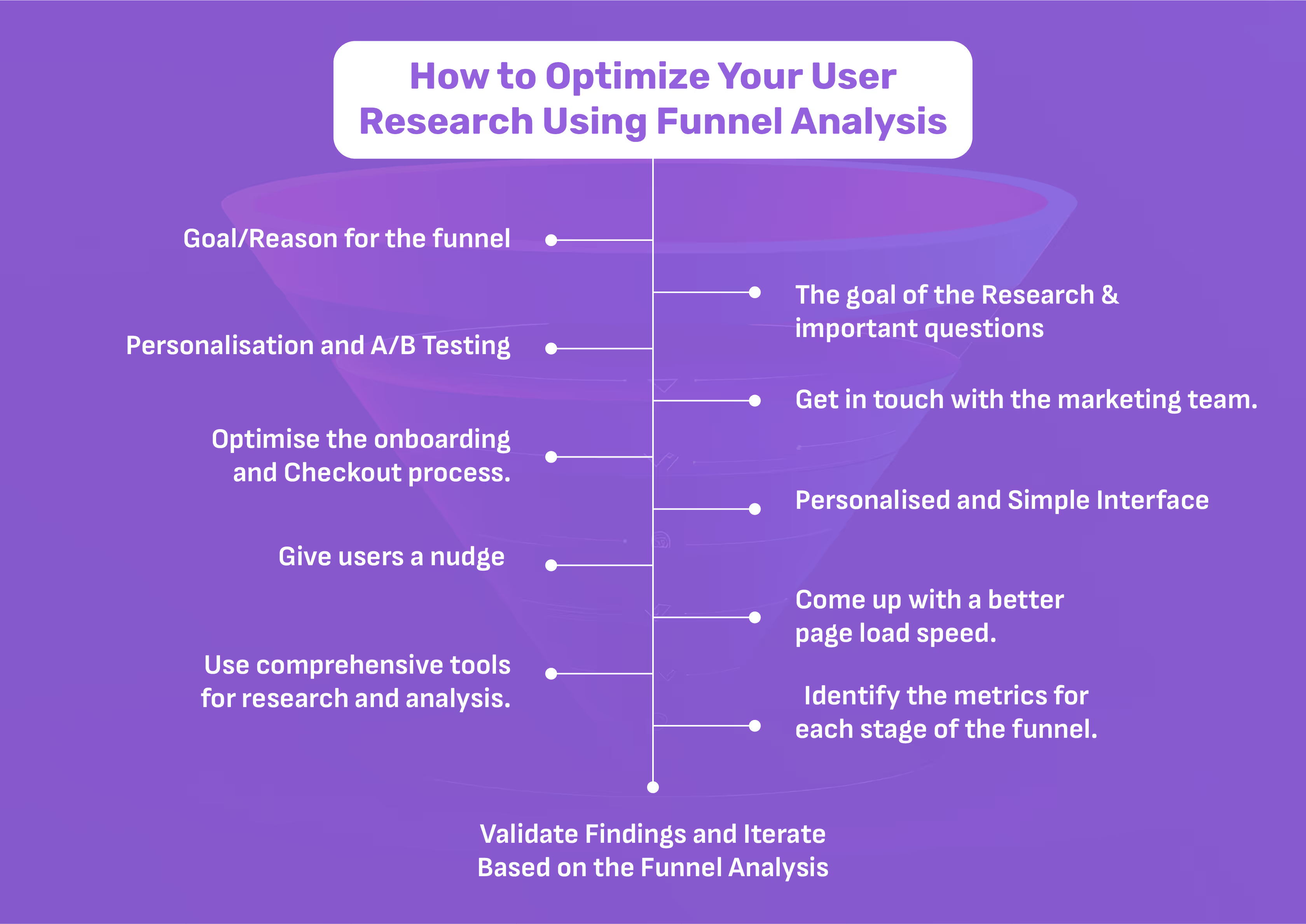
Now that youve examined conversion rates at each stage of the funnel and identified possible bottlenecks and drop-off points where users leave the website and app, its time to optimise the UX design through this research.Based on your findings in the resea

Let's create something amazing!
Let's discuss your vision and how we can bring it to life with impactful design solutions.
.avif)
Good design starts with Sliced Newsletter
Subscribe to the Sliced newsletter and get the best of research, UX writing, product psychology, CX, and design systems, right in your inbox.