How Our UX Design Agency Turns Fintech Concepts into Clickable MVPs in Weeks

Yellow Slice
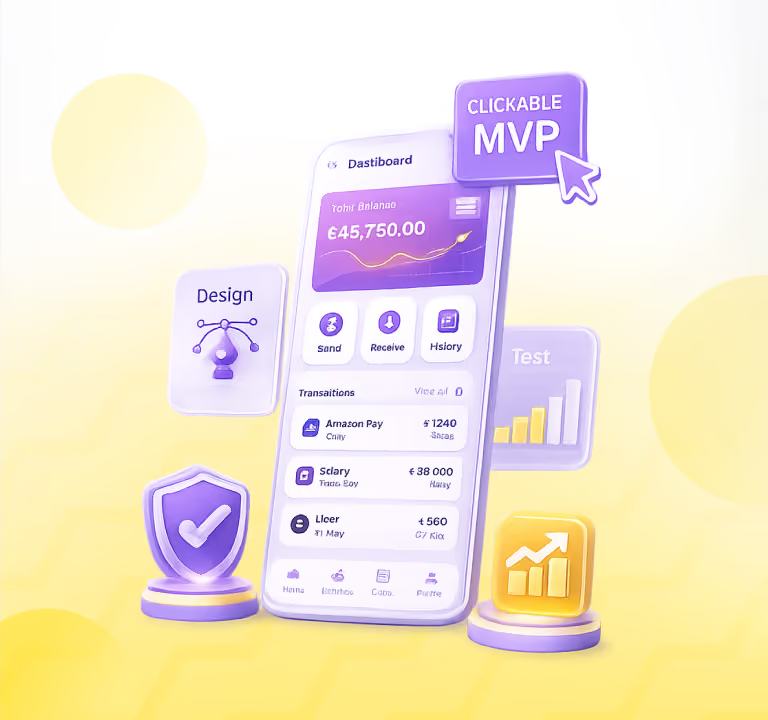
The fintech industry is growing rapidly and building a successful means of creating an app with a friendly user interface that works faster and easier than ever. Thats where UX design for fintech becomes important. At Yellowslice, they are designing a smooth and user-friendly experience through rapid MVP development. They create clickable MVPs that are simple versions or look-alikes of a real app that can be tested with real users for quick feedback before launching. This saves money and time with feedback to avoid guesswork.Whether you are building a mobile banking app, a budgeting tool, or a payment solution, YellowSlices fintech UX design process ensures your product is user-focused, tested, and ready to grow.
Understand the Fintech Market and Identify Growth Opportunities
Before the YellowSlice team starts designing any fintech app, they take time to understand the market. This helps them to build a product that users need.
- Discovering Market Trends: They explore the latest trends in the fintech digital space, like mobile-first banking, real-time payments, digital wallets, and embedded finance. For example, many users face issues with confusing interfaces or slow transactions. These are the problems that need to be fixed for a better fintech UX design.
- Understanding and Defining Your Target Users: At YellowSlice, they build user-based applications by understanding the behaviours, needs, and difficulties faced by the audience. For example, a recent survey shows that 75% of Indian UPI users ended up spending more because the payment experience was smooth and direct. Information like this guide makes user-friendly solutions through their UX design for Fintech.
- Analyzing the Fintech Competition and Market: The next step is to study other fintech apps in the market. The YellowSlice team finds all the details of other apps, like what makes them stay in the market, where are their difficulties faced by users, or how users feel about them. This helps to understand the gaps and opportunities to create a product that stands out.
- What makes your Fintech App Different: Based on all the above research, they define a unique value proposition for your app. This is a clear message that explains what problem your app solves and why users should choose your product over your competitors. A strong, unique value proposition(UVP) helps guide design and development, delivering real value from day one.
Defining The Right Features for Your Fintech MVP
At YellowSlice, they first understand the market and the users, and the next step is to define what the minimum viable product should include. This means understanding the smallest version of your app that delivers the real value to users. It helps the team to move fast, test early, and save on development costs.
- Identify Essential Features- They start by identifying the must-have features that solve the main problem for your users. At this stage, they avoid adding too many features that are extras and are just used for attracting. The goal is to keep the app simple and focused. For example, if its a digital wallet app, sending and receiving money securely is likely an essential feature.
- Develop User Personas- They create user personas, which are simple profiles that represent your typical users, including their age, job, financial habits, goals, and struggles. For example, one persona could be a 28-year-old freelancer who struggles with tracking irregular income. These personas help to understand what features people are looking for and guide them to make the right decision.
- The Unique Value Proposition- This is a fancy way of saying what makes your app special. This is how they clearly define how your app helps improve user experience. They offer faster money transfers with zero fees. Knowing this helps to focus their design and messaging around your apps strongest features.
- Align Features with Business Goals- The goal is not only for improved user experience but also to help your business grow faster. YellowSlice makes sure that your MVP supports your business goals, like:
1.Getting more users. 2.Increasing engagement. 3.Generating revenue.This means they don't waste time on features that are good-looking but don't help you move forward.
Deep User Research Before Designing Fintech App
At YellowSlice, they do user research before diving into design while making a fintech app. Here are a few steps to understand the users, their thought process, what they struggle with, and what they expect from your app:
- Talk to Real People- They talk with people who are most likely going to use your app. They do surveys, and for example, they ask questions such as what features people care about. Or how often do they use financial apps? These conversations and surveys give us a clear picture of your audience and what matters most to them.
- Watch How People Use the App- Once the rough version of your app, like a clickable MVP, they have, they ask people to try out and observe how they navigate the app, complete the tasks, or get stuck or are confused while using the app.
This helps to get a clear picture of what works well and what needs fixing before the app goes live.
- Map the User's Journey- They create a user journey map that shows step-by-step details of the user's journey while interacting with the app, from the moment they open the app to completing a task. By this, the YellowSlice team gets an overall picture of how the users are using the app.
Is the app running smoothly?Where are the users finding it difficult or getting confused?If yes, how to help them or simplify the steps would be good enough?
- Create User Flows- This is important in Fintech UX Design, where users often deal with complex tasks like payment, budgeting, or investments. Designing user flows helps to plan the structure of the apps so that they feel natural and easy to use. A clear flow means fewer mistakes, more trust, and better engagement.
Conducting User Interviews for a Better Insight
User interviews provide wider information about users lives, experiences, and challenges. These conversations help teams understand their users better and find ways to make their lives easier.
- Start with clear research goals tied to specific behaviours or feelings you want to learn about.
- Ask open-ended questions that give an accurate answer.
- Use follow-up questions to ask to understand the reasons for their answers.
- Write everything in a record of all the information you collect.
Structure Through Wireframes and Information Architecture
Once you know the users and their needs, its time to build the foundation of your fintech app. The YellowSlice team starts organizing everything step by step. This is where information architecture and wireframes come in as two key parts of Fintech UX design.
- Now let's understand what Information Architecture is.
Information architecture is how the content and features are organized in your app, so that users can easily find what they are looking for.For example, in a banking app, the Home screen shows your balance, a transfer section to send money, and a history section to show your transactions. Clear information architecture makes the app easy to navigate, and it is essential in UX design for fintech, where users find it difficult to process.
- Let's come to wireframes. These are blueprints of your app that are simply a black-white layout that shows the positions of buttons, menus, and text, and the information that will appear on screen.
Wireframes help to visualize the user experience early, so that changes can be made before investing time and designing.Step by Step: How YellowSlice Transforms Fintech Concepts into Clickable MVPsStepWhat YellowSlice Does?Why Does It Matter?Understanding marketIt analyzes what is trending in mobile banking, digital wallets, or investments.They make the product according to the user's needs and market gaps.User Research and PersonasIt does surveys, interviews, behaviour analysis, and persona creation.They make sure product decisions are made according to real-world usage.Define MVP ScopeIt defines the main features, discards the extras.They focus on developing solutions to a specific user problem efficiently.Information Architecture and WireframesIt builds user flows, wireframes, and organizes navigation.They create a logical structure before visual design.UI DesignIt applies brand identity, colors, icons, and typography to the app UITransforms wireframes into visually attractive interfaces.Clickable MVP CreationIt builds a no-code prototype app for interactions.They enable early testing without writing a single line of code.Usability TestingIt observes real users performing tasks and gathers informationIdentifies problematic points and improves usability before launching the real app.Repetitive ImprovementImprove the UI and UX based on testing information.Enhances user satisfaction and reduces post-launch rework.Developer Handoff and SupportWork alongside devs to ensure smooth MVP implementation.Speeds up development without any misunderstandingContinuous improvement Post-LaunchTracking usage, collecting data, and improving based on real behaviour of the real users.Keeps the product competitive, accurate, and user-focused.
Designing an Engaging UI and Clickable MVPs
After getting a planned structure of your fintech app with wireframes, its time to bring it alive. This is the part where the team moves the app from black-and-white sketches to full-color, polished screens that show your apps brand personality. This is called UI design, and it is the main part of creating a great UX design fintech experience.
- Designing the Final look- They start designing high-quality, detailed screens using brand colors, Fonts, Icons, and illustrations, and Layouts.
- Building Clickable MVPs- Once the final design is ready, they create a clickable MVP, which is a prototype of the real app without code, which helps to track the flow of the app when real users click buttons and go to different screens. It helps to mark the difficulties faced by the users.
- Why Clickable MVPs are useful- this helps to learn whats working well for the users, and what they need in general. You can also learn about the areas that need improvement, and this helps all the team members to understand the product and make a single decision. This also works as a fundraiser. For example, if you meet an investor, a working prototype shows your serious commitment to the product.
At YellowSlice, they design with a purpose. Their UX design fintech approach means every color, icon, and screen layout is tested and backed by real user feedback. They make your app pretty and useful, with clear navigation, and trustworthy, improving user experience.
Testing and Improving with Real Users
Building an app that looks nice and attractive is not the real purpose. While making a fintech product here, what matters most is to make sure the users find it easy to use, the app works faster, and is understandable by everyone without any difficulty.Here are the steps that show whats working and what needs to be fixed before investing time and money:
- Heres how they test- They give your clickable MVP to users and ask them to complete the main tasks like sending money and checking balance, or creating a budget.
- Use Feedback to Improve- After testing, they refine the design and fix anything that is confusing or difficult to understand, and make navigation easier by simplifying steps.
Smooth Launch of Rapid MVP Development
Once your design is finalized and tested, they work side by side with your development team to make sure everything runs smoothly. This is how YellowSlice supports Rapid MVP development from design to launch.
- They support developers at every step to make sure there are no delays or confusion.
- From design to launch, they are all part of the Rapid MVP development approach.
Post-Launch Improvements
Launching your MVP is just the beginning; here, the real users start using your app.At YellowSlice, they continue to support you after launch to help you make your fintech product even better.
- Track user behaviour
- Collect Feedback
- Plan what to improve next
This continuous improvement process is the way in UX design for fintech projects that help your app stay relevant, user-friendly, and competitive after launch.Key Highlights of YellowSlices UX Fintech Process
- Clickable MVPs in Weeks
- User-focused Design Approach
- Mobile-first fintech focus
- Tested UX solutions, not assumptions
- End-to-end Iterative Process
- Close collaborations with Development Teams
Work with YellowSlice to bring your fintech vision into reality. At YellowSlice, they have helped startups and enterprises to launch their fintech products with confidence. Their team combines deep industry knowledge with smart design and Rapid MVP development.Together, you can build clickable MVPs that solve real problems and make the users feel delighted and stress-free. Turn your fintech idea into a functional, testable, and investor-ready product in just a few weeks. Make it happen only with YellowSlice, a design consultancy with innovative solutions.Ready to start your fintech UX journey? Contact YellowSlice, a design consultancy, and create something meaningful.
FAQs about How Our UX Design Agency Turns Fintech Concepts into Clickable MVPs in Weeks
1. What is an MVP in fintech?
An MVP(Minimum Viable Product) is the basic version of your app with just the key features, basically a prototype to test with the real users before building the full project.
2.Why is UX design important in fintech apps?
Good UX design makes fintech apps easy to use, improving user experience and generating revenue for the company.
3.What is Rapid MVP development?
Rapid MVP development is a fast way to build and launch a basic version of your app. This focuses only on the key features to save time, reduce costs, and gather feedback quickly.

Let's create something amazing!
Let's discuss your vision and how we can bring it to life with impactful design solutions.
.avif)
Good design starts with Sliced Newsletter
Subscribe to the Sliced newsletter and get the best of research, UX writing, product psychology, CX, and design systems, right in your inbox.